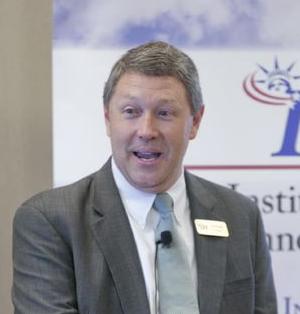
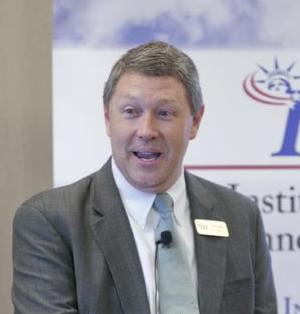
Tom Giovanetti is president of the Institute for Policy Innovation (IPI), a 38-year-old conservative, free-market public policy “think tank” based in Dallas, Texas.
In addition to his administrative and fundraising duties, Tom writes for IPI and for leading publications on a variety of policy topics including tax policy, economic growth, self-government, civil liberties and constitutional protections, judicial supremacy, intellectual property, Social Security personal accounts, technology and Internet policy, and government spending. In addition to being regularly published in major outlets including the Wall Street Journal, Washington Times, FoxNews.com and The Dallas Morning News, Tom writes often for the Fort Worth Star-Telegram. Tom frequently appears in the media and is a regular guest and occasional substitute host of the Mark Davis Show in the Dallas-Fort Worth market.
Tom loves thinking out-of-the-box to design novel solutions to policy problems and explaining complicated policy issues in ways average folks can understand.
Tom's mission at IPI is to use issues to teach conservative, free market thinking and to push back against unprincipled populism. He seeks to encourage continued skepticism of Big Government, to maintain faith in markets, and to defend individual liberty as the best means of achieving human flourishing. His most recent work has focused on free market solutions to student loan debt, preserving online freedom, and persuading state legislatures to override local and municipal rules that restrict economic liberty.
Mr. Giovanetti has represented IPI at many national and international organizations, including the World Intellectual Property Organization (WIPO), the Internet Governance Forum (IGF), and represented IPI during negotiations on the Trans-Pacific Partnership (TPP) trade agreement. Mr. Giovanetti is a popular speaker and writer and testifies before state and federal legislative committees on a variety of topics.
Follow Tom on Twitter (X) at @tgiovanetti
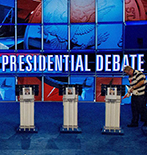
The Most Important Tax Reformer Was Not On the Debate Stage
For tax reform, new Ways & Means Committee Chairman Kevin Brady's priorities matter more than those of any presidential candidate.
Upside and Downside of Investing in a myRA, Uncle Sam's Newest Savings Plan
"Don't bother with the myRA," said Giovanetti. "The myRA is touted as a safe, easy, affordable savings plan for workers -- it invests in only U.S. Treasury securities. The website brags about how there are no fees and no complications for employers, and that it's a Roth IRA."

Don't Bother with myRA
Today, the Treasury Department rolled out the new myRA retirement accounts with almost no fanfare. And it’s easy to see why: The myRA is a retirement savings policy embarrassment.
Texas Fracking Battles Quiet For Now With Potential Storms Brewing
In Texas, more fracking ban battles are likely ahead with a state v. local control companion issue a new part of the mix. Denton’s fracking battle is, for now, resolved, but a larger ideological storm is undoubtedly looming.
Institute To Hold Town Hall In Irving
The Institute for Policy Innovation will host a town hall meeting at its offices in Irving, and the speakers will be State Sen. Don Huffines, Irving Mayor Beth Van Duyne and institute president Tom Giovanetti. The topic is “Local Control vs Liberty.”
Obama Takes A Swipe At His Own Recovery
During August, the Labor Department said another 261,000 people permanently dropped out of the labor force. "That's a net loss of 88,000 jobs, not an increase, " according to IPI President Tom Giovanetti. The labor force participation rate has been stuck for three months at its lowest rate since 1977, Giovanetti asserted. "That's not good news — that's a disaster, " he said.
Sugar Policy
When the maker of Oreo cookies announced it was moving one assembly line from Illinois to Mexico, it said the decision was the result of labor unions, not the price of sugar.

The Laws of Economics Mock the FCC
The FCC's net neutrality regulatory order has resulted in a massive hit to U.S. economic investment, and there is every reason to expect it to continue, writes IPI president Tom Giovanetti in RealClearMarkets. It's yet another self-inflicted wound on our economy through poor policy decisions.
FCC Fails to Suspend the Laws of Economics
The early data is in: The FCC's onerous new regulation has resulted in a precipitous drop in broadband investment.
Total Records: 771

