

by Gary & Aldona Robbins
TaxAction Analysis
Introduction
While policy makers bemoan America’s low savings rate in comparison to other industrialized countries, many of these same policy makers overlook the effects of tax policy on incentives to save and invest. Since 1981, tax policy has both helped and hindered efforts by average Americans to save. The Economic Recovery Act of 1981 (ERTA) provided several savings incentives for average Americans. ERTA cut individual income tax rates across-the-board by 25 percent, which allowed savers to keep a larger share of investment income aftertax. ERTA also expanded the availability of tax-free Individual Retirement Accounts (IRAs) and increased the amount of an estate that could be passed to heirs without tax. But many of ERTA’s benefits to savers have been undone through subsequent tax legislation.
The Tax Reform Act of 1986 contained good and bad news for average savers. Tax reform further lowered individual rates by reducing the number of brackets from eleven to two and by cutting the top rate from 50 percent to 28 percent. However, it also broadened the tax base as a way to pay for the rate cuts. One of these base-broadening measures restricted the availability of IRAs for many American workers, removing much of their incentive to save. And the tax rate increases enacted in 1990 and 1993 have further inhibited their ability to save.
Two provisions in the Republican "Contract with America" would provide increased saving incentives for average Americans. One is a new, IRA-like savings account, and the other is an increase in the amount of an estate that is exempt from tax.
Current Tax Treatment of IRAs
Individual retirement accounts (IRAs) came on the scene in 1974. The Employment Retirement Income Security Act (ERISA) established IRAs so that workers who were not covered by an employer-sponsored pension plan would have access to a suitable vehicle for retirement savings. Workers without pension plans could make tax-deferred contributions of up to $1,500 until retirement age, with penalties for early withdrawal. In 1978, 1.5 million of the 33.2 million eligible workers had opened IRAs.1
| Year | Amount ($bil.) | Returns (mil.) | Average Contribution1 | Average Contribution ($1987)2 |
|---|---|---|---|---|
| 1980 | 3.4 | 2.6 | $1,338 | $1,866 |
| 1981 | 4.8 | 3.4 | $1,391 | $1,764 |
| 1982 | 28.3 | 12.0 | $2,354 | $2,811 |
| 1983 | 32.1 | 13.6 | $2,355 | $2,702 |
| 1984 | 35.4 | 15.2 | $2,322 | $2,551 |
| 1985 | 38.2 | 16.2 | $2,358 | $2,499 |
| 1986 | 37.8 | 15.5 | $2,430 | $2,508 |
| 1987 | 14.1 | 7.3 | $1,922 | $1,922 |
| 1988 | 11.9 | 6.4 | $1,868 | $1,798 |
| 1989 | 10.8 | 5.8 | $1,859 | $1,713 |
| 1990 | 9.9 | 5.2 | $1,887 | $1,666 |
| 1991 | 9.0 | 4.7 | $1,935 | $1,646 |
| 1992 | 8.7 | 4.5 | $1,943 | $1,607 |
- Contribution amount in column 2 divided by number of returns in column 3. ↩
- Average contribution amount in column 4 adjusted for the GDP deflator. ↩
Source: Internal Revenue Service, Statistics of Income Bulletin, Washington, DC, Fall 1994, Table 1.
The Economic Recovery Tax Act of 1981 (ERTA) extended IRAs to virtually all workers and raised the maximum deductible contribution to $2,000. Participation in IRAs grew rapidly and, by 1985, 16.2 million taxpayers reported IRA contributions amounting to $38.2 billion on federal income tax returns. [See Table 1.]
The Tax Reform Act of 1986 changed Individual Retirement Accounts (IRAs) in two significant ways. First, it limited the tax-free IRA contribution to only those not covered by an employer-provided pension plan, or to those with incomes of under $25,000 for individuals and $40,000 for married couples. Second, the Act dramatically reduced marginal tax rates. The marginal rate reductions cut the tax advantage of IRAs relative to a regular savings plan by about 40 percent.
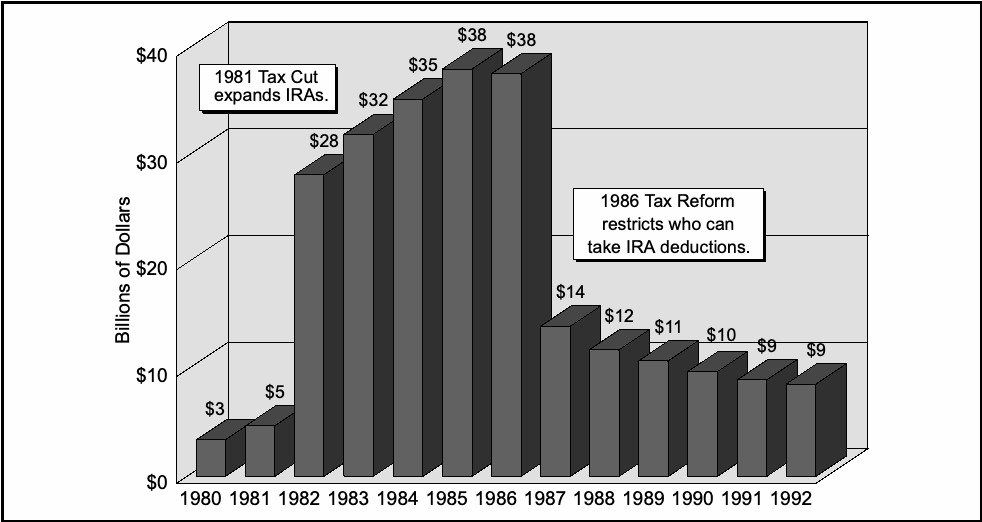
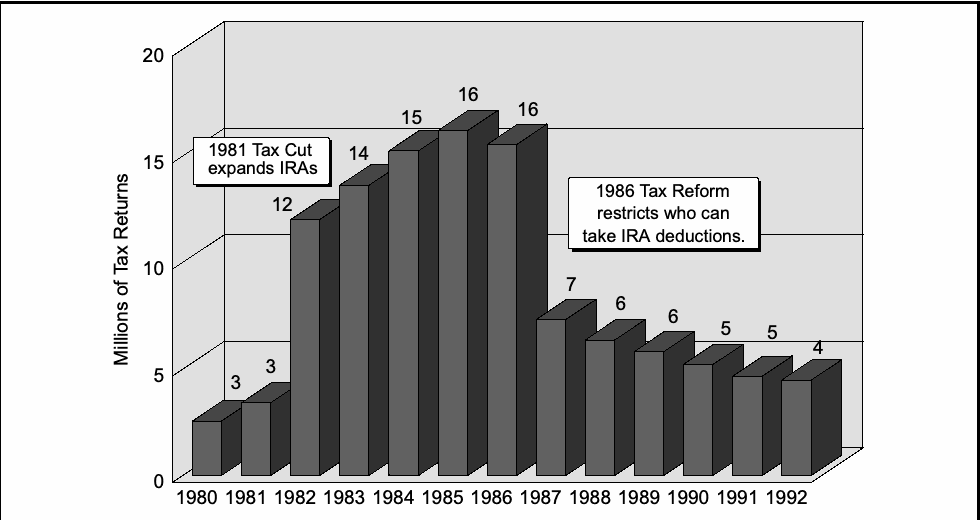
The combination of lower rates and reduced eligibility for the initial deduction has reduced IRA participation to less than one-fourth of what it was in 1985. In 1992, the latest year for which data are available, only 4.5 million taxpayers reported IRA contributions totaling $8.7 billion. [See Figures 1 and 2.]
Apart from concern over national savings, declining IRA contributions are worrisome for another reason. As Social Security’s financial troubles become increasingly apparent, baby boomers and generations to follow should be saving more, not less, for retirement.
Contract Proposal to Establish a New Tax-free Savings Account
The "Contract with America" would go a long way toward restoring the saving incentives of IRAs. It proposes to allow individuals to contribute up to $2,000 a year into an "American Dream Savings Account." The tax liability of the account would be back-ended, meaning that individuals would pay taxes on contributions but not on withdrawals. The $2,000 contribution limits would be indexed for inflation beginning in 1996, and the contribution for a nonworking spouse would be increased from $250 to $2,000.
Earnings on assets in the account would continue to accumulate free of tax as they do with current IRAs. In addition to retirement savings, withdrawals from the account also could be made without penalty for first-time purchase of an owner-occupied home, family college expenses and medical expenses.
An additional feature would allow people who currently have IRAs to transfer funds into the new account. Because contributions to the new accounts are taxed while withdrawals are tax-free, the individual would pay tax on any transfers from existing IRAs. The transfer option would have to be exercised during 1995 or 1996.
Economic and Revenue Effects
The Joint Committee on Taxation (JCT) estimates that the creation of a new savings account would pick up $2.2 billion in revenue over the first five years. The reason for the gain is the taxes that would paid on transfers from existing IRAs. JCT estimates that between 2000 and 2005 the proposal would lose $6.8 billion. [See Table 2.]
| Fiscal Years | American Dream Savings Account | Increase Estate Tax Exclusion |
|---|---|---|
| 1996-2000 | $ 2.2 | $ -6.8 |
| 2001-2005 | $ -26.1 | $ -13.9 |
| 1996-2005 | $ -23.9 | $ -20.7 |
Source: Joint Committee on Taxation, “Estimated Revenue Effects of the Tax Provisions Contained in the ’Contract with
We believe that the JCT estimates are too pessimistic even on a static basis. IRAs and Keogh plans currently hold about $1 trillion in assets. If tax rates go up in the future, people would be better off paying tax now rather than later. We estimate that about 20 percent of current IRA holdings would be converted ($80 billion in conversions in 1995 and $120 billion in 1996). If transfers of that size occur, the federal government would pick up almost $50 billion between 1995 and 2000. JCT, on the other hand, assumes transfers from existing IRAs would amount to less than one-half percent of assets.
Positive economic effects from expanding savings and investment would also add to federal revenue gains. Some argue that IRAs have not produced new savings because taxpayers simply shift assets from taxable savings accounts. The weight of economic research, however, finds that IRAs have had a substantial positive effect on personal savings. Data show that many families would quickly run out of liquid assets to shift into IRAs if they were not doing new savings.2 Research by National Bureau of Economic Research economists finds that 80 percent of additional IRA contributions are new savings by individuals. Fifty cents of each additional savings dollar come from reduced consumption, 20 to 30 cents from reduced taxes, and at most 20 cents from other savings. As a result, the net increase in national savings equals over half the IRA contribution.3
Our results are in line with these findings. We estimate that the Contract proposal would reduce the economy-wide marginal tax rate on capital by 0.6 percent, and would lower the cost of capital by 0.5 percent. By the year 2000, higher investment would increase capital formation in the U.S. by $146 billion. This larger stock of U.S. capital would lead to the creation of 42,000 new jobs, and annual GDP would be $18 billion higher than otherwise. [See Table 3.] As a result, the revenue gains from added growth would continue to outweigh the static loss over the long run.4
Current Estate Tax Treatment
Under current estate tax rules, all estates receive a unified credit of $192,800 against estate tax liability. This credit effectively excludes the first $600,000 of gross estate from tax. Over $600,000, estates are taxed at graduated rates, starting at 37 percent and reaching 55 percent for estates of over $3 million.
Estates of average taxpayers who purchased homes 20 or 30 years ago, or who have built up a family business, can easily be worth hundreds of thousands of dollars. The purpose of the credit, which has been in place since 1987, is to remove the estates of lower and middle-income taxpayers from the tax rolls.
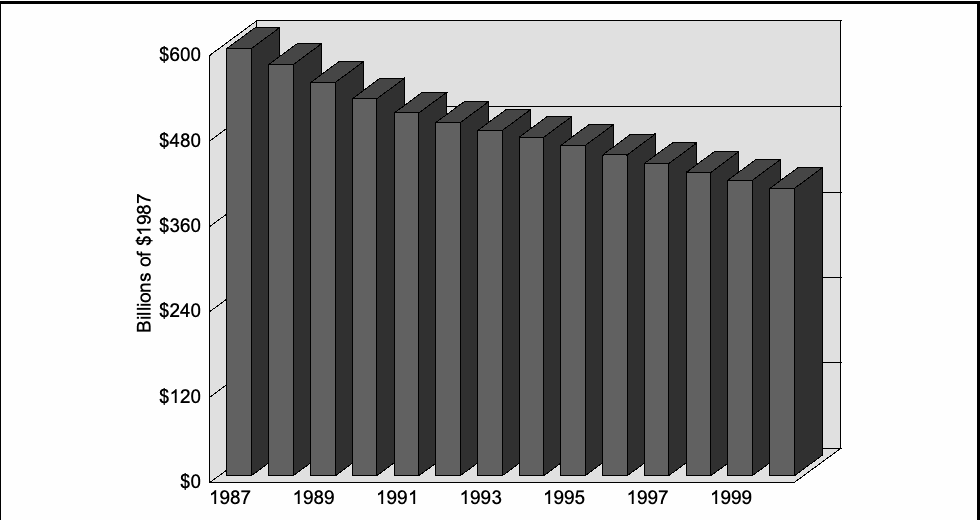
Because the credit is not indexed for inflation, "bracket creep" along with rising income and asset values make estates of more middle-income taxpayers taxable today than in 1987. Inflation alone has eroded the value of the exclusion by 22 percent since 1987. [See Figure 3.] In 1994 dollars, the $600,000 exclusion translates into $776,302.
Contract Proposal to Increase Exclusion to $750,000
The "Contract with America" proposes to increase the unified credit to $248,300, effectively excluding $750,000 in gross estate from tax. The new credit would be indexed for inflation after 1995.
Economic and Revenue Effects
The Joint Committee on Taxation estimates that increasing the exclusion to $750,000 would cost $6.8 billion over the next five years and $20.7 billion over the next ten. The added cost comes from not only removing estates from the tax rolls, but also from reducing the tax on taxable estates.
The estate tax is really a tax on the transfer of assets to heirs. If heirs do not have sufficient funds to pay the tax, they often must sell off assets. In the case of a family business or farm, heirs may have to close down an otherwise sound enterprise. In other words, the estate tax represents another layer of taxes on capital.5
| Year | GDP ($bil. Nom.) | Jobs (mil.)2 | Capital ($bil. Nom.) |
|---|---|---|---|
| 1995 | 1.1 | 0.002 | 10.0 |
| 1996 | 3.2 | 0.006 | 29.2 |
| 1997 | 5.9 | 0.013 | 52.0 |
| 1998 | 8.7 | 0.021 | 74.9 |
| 1999 | 11.8 | 0.030 | 98.9 |
| 2000 | 14.6 | 0.038 | 119.1 |
| 1995-2000 | 45.3 |
The Contract proposal would reduce the economy-wide marginal tax rate on capital by 0.3 percent, and would lower the cost of capital by 0.3 percent. By the year 2000, higher investment would increase capital formation in the U.S. by $119 billion. This larger stock of U.S. capital would lead to the creation of 38,000 new jobs, and annual GDP would be $15 billion higher than otherwise. [See Table 4.] Because of this higher growth, dynamic revenue gains from higher income, payroll and excise taxes would offset the static revenue loss from the estate tax.
Conclusion
Rising taxes have made saving less and less attractive for average Americans. One popular tax-favored savings vehicle, the Individual Retirement Account, was severely limited by tax reform in 1986. And inflation has eroded over one-fifth the protection provided for estates of middle income Americans. By making available a new IRA-like account, and by insulating the estate tax credit from inflation, the Contract for America would restore most of these saving incentives aimed at average Americans.
Endnotes
- Emily Andrews, The Changing Profile of Pensions in America, Washington, DC: Employee Benefit Research Institute, 1985, pp. 78-82. ↩
- For a survey of the literature see Norman B. Ture and Stephen J. Entin,Save America: A Primer on U.S. Saving and Its Effect on Economic Health, Washington, DC: Institute for Research on the Economics of Taxation, 1989, pp. 28-31. ↩
- Stephen F. Venti and David Wise, "IRAs and Saving," in M. Feldstein (ed.), Taxes and Capital Formation, Chicago: University of Chicago Press, 1986; Venti and Wise, "Tax Deferred Accounts, Constrained Choice and Estimation of Individual Saving," Review of Economic Studies, August 1986; Venti and Wise, "The Evidence on IRAs," Tax Notes, Jan. 25, 1988. ↩
- Gary and Aldona Robbins, Putting the Economy Back on the Growth Track: Six Steps to ’Upsize’ the Economy, Lewisville, TX: TaxAction Analysis, September 1994. ↩
- For a discussion see Richard E. Wagner, Federal Transfer Taxation: A Study in Social Cost, Washington, DC: The Institute for Research on the Economics of Taxation and The Center for the Study of Taxation, 1993. ↩
About TaxAction Analysis
TaxAction Analysis is the tax policy arm of the Institute for Policy Innovation, a non-profit, non-partisan public policy organization. TaxAction Analysis recognizes that changing tax policy affects incentives to work, save, and invest. These changes in economic behavior are frequently ignored in static government forecasts, resulting in policy decisions that negatively affect economic growth, capital formation, employment, and local, state, and federal revenues. TaxAction Analysis publishes Economic Scorecard, a quarterly newsletter, as well as additional commentary on tax policy.
TaxAction Analysis features the work of John M. Olin Senior Research Fellow Gary Robbins and Bradley Senior Research Fellow Aldona Robbins, both of Fiscal Associates, Inc. The Robbins, both former Treasury economists, make use of a general equilibrium model of the U.S. economy that explicitly incorporates detailed information on tax policy and how it affects the economy, capital investment, output and jobs.
Note: Nothing written here should be construed as necessarily reflecting the views of the Institute for Policy Innovation or those of its directors, or as an attempt to aid or hinder the passage of any bill before Congress.
Original Publication Information
Institute for Policy Innovation · IPI Issue Brief · March 1995
Contact information as printed in 1995:
Institute for Policy Innovation
250 South Stemmons, Suite 306
Lewisville, Texas 75067
(214) 219-0811