

Introduction
Now that the Clinton-Gore administration is winding down, both men would have us believe that today’s superb economy and large federal budget surpluses are a result of their “New Economic Plan” (NEP). The NEP, enacted in 1993, consisted primarily of a huge tax rate increase and planned large budget deficits for the duration of a two-term Clinton presidency. President Clinton is touting the NEP because of his obvious concern for his legacy, and Mr. Gore is using the NEP as a primary argument for his election as President.1 The Gore-2000 web page contends: “[Gore] cast the deciding vote for the 1993 Administration Economic Plan which helped to eliminate the federal budget deficit and provided incentives to promote economic growth.” During the first presidential debate in the 2000 campaign, the vice president went further: “I had the honor of casting the tie-breaking vote to end the old economic plan here at home and put into place a new economic plan that has helped us to make some progress, 22 million new jobs, the greatest prosperity ever.”2
The historical record belies these assertions. The United States is indeed experiencing “the greatest prosperity ever” but empirical evidence demonstrates that it is in spite of, not because of, the Clinton-Gore “new economic plan.” To appreciate this fact, it is important to grasp precisely what the proponents of the 1993 tax increase thought they were accomplishing, the logic behind their plan as well as what actually happened and why.
Keynesian Foundation of the Clinton-Gore “New Economic Plan”
When Bill Clinton and Al Gore took office in 1993, the economy was rebounding slowly from the 1990-91 recession. In the words of the Congressional Budget Office (CBO) at the time, “The economic expansion has become self-sustaining, although the pace of growth is below average for this stage of the business cycle.”3 Although there were two policy mistakes that accounted for the abnormally slow pace of the recovery—a large tax rate increase in 1990 combined with a credit crunch brought on by an ill-conceived regulatory onslaught in the financial services industry engineered by the Bush Administration in an over reaction to the savings and loan crisis—the Keynesian economic model approved of both policies and identified budget deficits as the primary culprit.4
There was widespread agreement among economists of all stripes that the economy should have been growing faster during the “rebound phase of the business cycle” than the 2.7 percent annual rate it was achieving in 1993.5 There was disagreement, however, over the means of achieving a higher rate of growth during the recovery phase, and more fundamentally there was disagreement over the long-run, non-inflationary growth rate to which the economy could aspire after settling back from the recovery phase into a sustained expansion phase.
Operating within a Keynesian framework, CBO placed the long-run growth potential of the economy around two percent a year because it believed the uptick in productivity growth then occurring was cyclical and unsustainable.6 The Clinton-Gore Administration, only slightly more optimistic, projected that “GDP growth of 2½ percent to 3 percent per year—in line with 1993 growth—seems likely to continue over the rest of the 1990s.”7 The economy’s long-run growth potential the administration put at “a little below 2.5 percent.”8
By contrast, classical supply-side economists argued that large budget deficits were the effect, not the cause, of an economy growing too slowly, and that the recent recession was not a naturally occurring cyclic event but rather the result of a poisonous mixture of tax rate increases, regulatory excesses and unwarrantedly tight monetary policy engineered by the Fed in an ill-considered effort to squeeze inflation out of the system too quickly.9
Supply-side economists argued that a policy foundation for accelerated productivity growth and faster economic expansion had been put in place during the 1980s and that combined with the widespread computerization and “downsizing” of businesses then underway, sustained, non-inflationary economic growth could be maintained at a rate between three and four percent a year.10 Regaining economic momentum, therefore, only required removing the policy impediments to growth that had been introduced by the Bush Administration in the early 1990s. Specifically, supply side economists argued for repealing the 1990 tax rate increase and lifting the regulatory assault on the financial services industry to alleviate the growing credit crunch that was stifling the economic recovery.11
Since the Clinton-Gore Administration perceived deficits as the cause, not the effect, of a sluggish economy, the NEP was designed around raising tax rates to reduce the deficit. The Keynesian chain of causation runs from higher taxes to “sustainable” growth as follows: higher tax rates produce more tax revenue, which results in smaller deficits, which enlarges the savings pool and increases the supply of loanable funds, which lowers interest rates, which encourages investment, which produces sustainable, non-inflationary economic growth.12
There is an obvious practical tension within this extended syllogism. Reducing the deficit is considered to be the sine qua non of maintaining economic growth, but the need to restrain the economy from growing “too fast” (i.e., above potential) in order to achieve “sustainable, non-inflationary” economic growth puts a limit on how fast the deficit can be allowed to fall. In other words, today’s sustained, non-inflationary four-percent growth rate not only was not the stated objective of the NEP, it was considered to be impossible.13
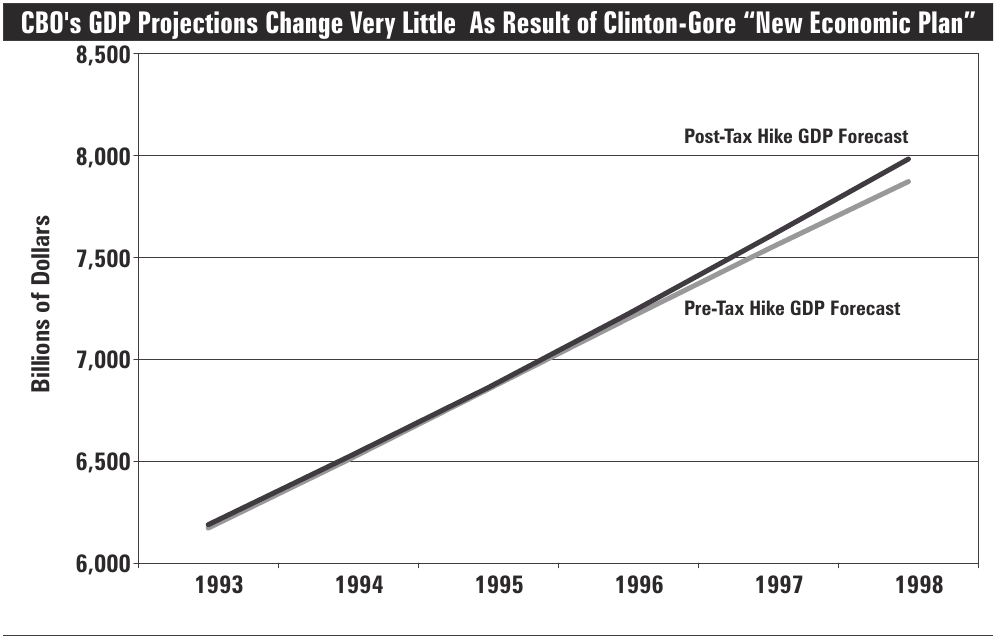
The Congressional Budget Office reflected this tension and revealed its low expectations for the “new economic strategy” in its Economic and Budget Outlook update in September, 1993. Regarding economic growth, CBO said the economic outlook had changed very little since before the tax increase was enacted:
From 1995 through 1998, CBO projects that real GDP growth will average 2.6 percent….CBO has revised its outlook for potential growth of the economy during the projection period upward to 2.1 percent per year, a rate that is 0.1 percentage point faster than last winter’s projection….The upward revision reflects the influence of higher national saving that should result form deficit reduction….With smaller deficits . . . the federal government will absorb a correspondingly smaller amount of national saving. As a result, more saving will be available to invest in private domestic plant and equipment—the primary basis for improving the level of GDP and living standards in the long run.14
Figure 1 depicts the similarity between CBO’s economic growth forecast a few months before enactment of the tax increase, in January 1993, and a month after enactment, September 1993.
On budget deficits, CBO said:
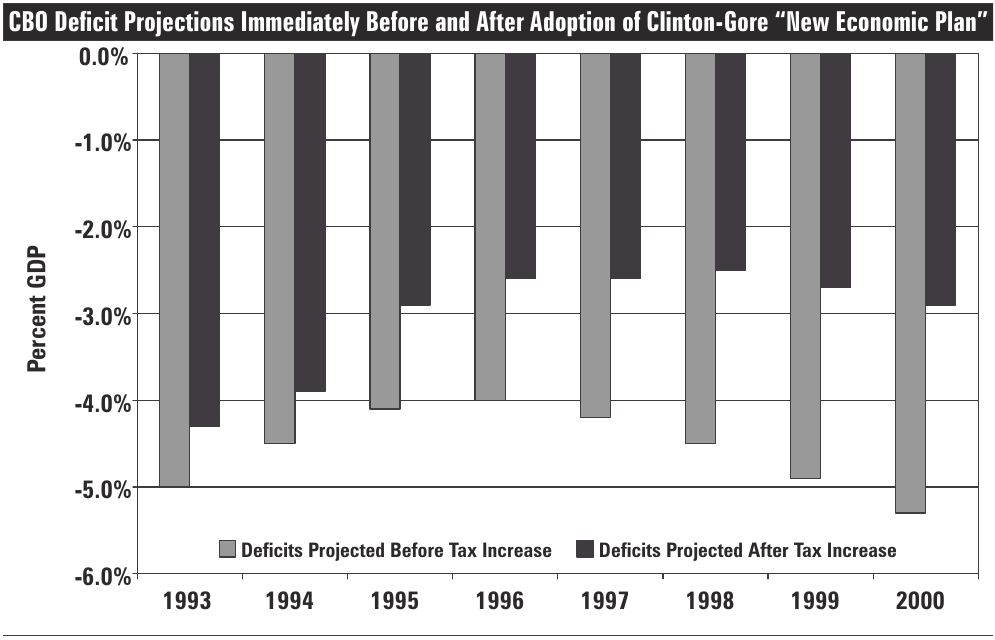
CBO projects that the federal budget deficit will fall from an estimated $266 billion in the current fiscal year to an average of $200 billion in 1995 through 1998. But beyond this horizon the deficit threatens to rise again unless the President and the Congress take further corrective actions.15
Figure 2 illustrates how the NEP was expected to affect budget deficits through the turn of the century. The main expected effect was to reduce CBO’s projection of the deficit to below three percent of GDP after 1995 through 1998 before it began again to grow gradually as far out as the eye could see.
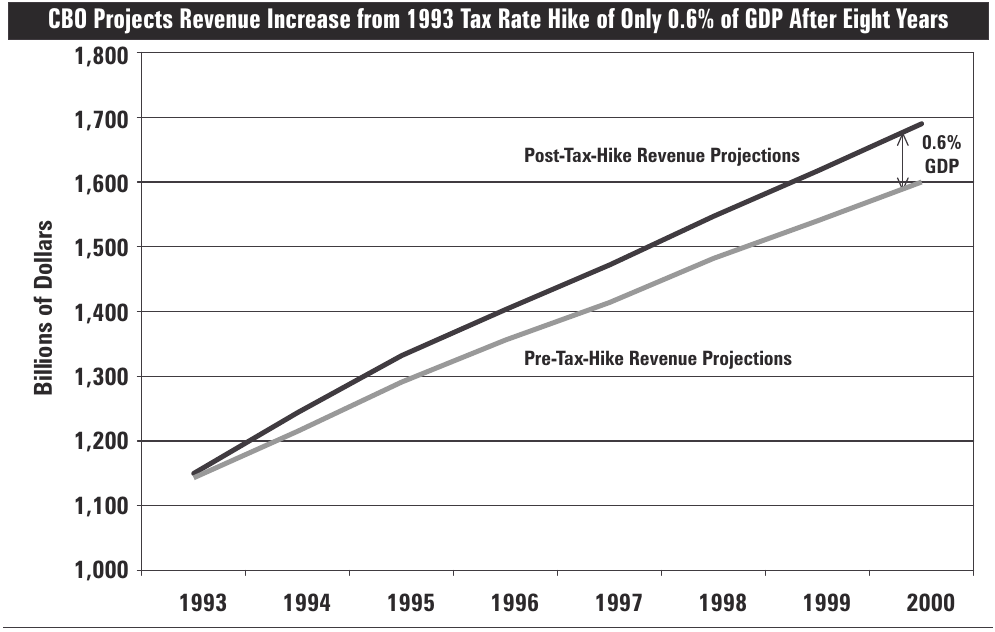
The main reason for this pattern was that the Omnibus Reconciliation Act of 1993 cut outlay growth relatively little, and although the tax rate increase was the largest in history at the time, the revenue increase projected by CBO amounted to only slightly more than a half percent of GDP by 2000. Figure 3 compares CBO’s revenue estimates in January before enactment of the 1993 tax increases to its September projections immediately after enactment.16
The Real Source of “The Greatest Prosperity Ever”
The evidence is in, and it is unambiguously clear that supply-siders were correct and the demand-siders were wrong in the 1990s, just as they were in the 1980s about the Reagan economic program. The huge tax rate increase of 1993, the heart of the Clinton-Gore NEP, failed to reduce the deficit significantly because it simply prolonged the sluggish economic recovery. By 1996, the economy was only about 17 percent larger than it had been at the bottom of the recession in 1991. By contrast, at a similar point in the 1960s economic expansion, the economy was almost 35 percent larger than at the trough of the 1961 recession.17
As Table 1 reveals, except for the Fed-induced, 4-percent growth rate in 1994, the sluggish economic expansion continuing through the first three years of the NEP conformed to the Clinton-Gore’s expectations of slow growth and persistent budget deficits.18
| Year | Actual Real Growth Rate | Projected Real Growth Rate (September, 1993) |
|---|---|---|
| 1993 | 2.7 % | 2.6 % |
| 1994 | 4.0 % | 2.7 % |
| 1995 | 2.7 % | 2.7 % |
| 1996 | 3.6 % | 2.7 % |
| 1997 | 4.4 % | 2.6 % |
| 1998 | 4.4 % | 2.4 % |
| 1999 | 4.2 % | 2.1 % |
| 2000 | 4.0 % est | 2.1 % |
| Average (’93-‘98) | 3.8 % | 2.5 % |
Because CBO’s substantially under estimated economic growth (by 52 percent between 1993 and 2000), its revenue estimates were also widely off the mark. Figure 4 compares CBO’s 1993 revenue estimate with revenues that actually flowed into the federal treasury between 1993 and 2000.
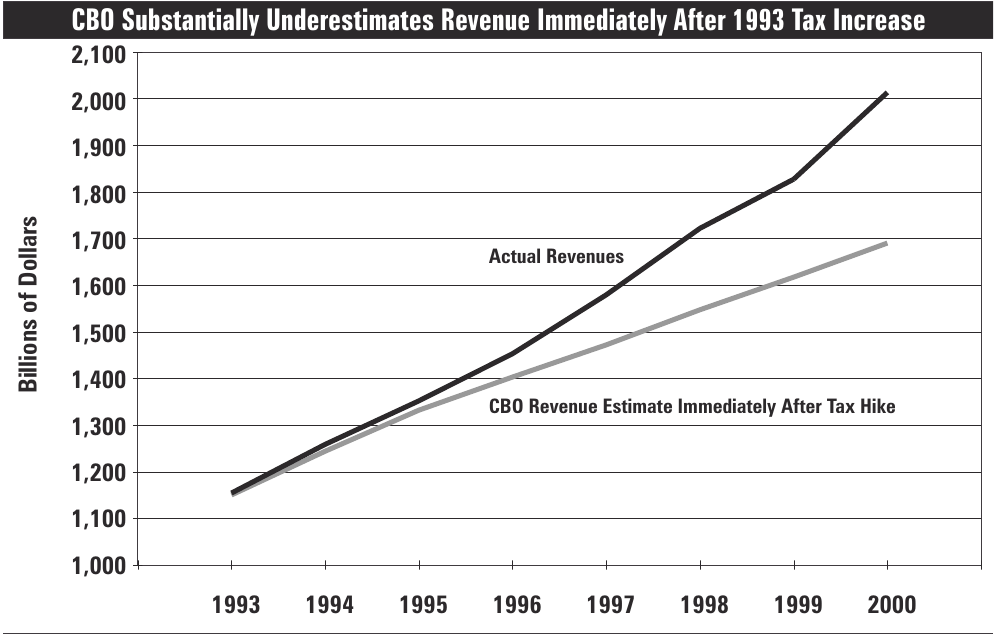
In summary, contrary to after-the-fact assertions by the Clinton-Gore Administration, the essence of the NEP never was to be rapid economic growth nor was it envisioned as transforming deficits into surpluses. To the contrary, the Clinton Administration, as late as May, 1998 was projecting real GDP growth of only 2.0 percent in 1999 and 2000, rising thereafter to only 2.4 percent a year.
The real source of today's prosperity was the exact opposite of the Keynesian prescriptions contained in the NEP: a virtuous combination of tax rate reductions enacted by Congress in 1997 over the objection of the Clinton-Gore Administration and the elimination of inflation combined with spending constraints and the high-tech revolution that has pushed productivity growth faster and higher than was believed possible.
Trapped inside the Keynesian paradigm, administration and congressional economists made two fundamental mistakes. First, they underestimated the capacity of the economy to grow at a rapid pace without inflation. Indeed, the NEP’s slow-growth strategy was a self-fulfilling prophecy since the very tax increases that were at its center kept growth down. The second error was to underestimate the elasticity of the progressive tax code with respect to economic growth.
The extent of the latter error is revealed in Figure 5, which adjusts the September, 1993 CBO revenue estimate to account for actual economic growth. The gray line in the figure depicts what CBO’s revenue estimate would have looked like in September 1993, immediately after the tax increase was enacted, if the CBO economists had possessed perfect foresight with respect to the economic growth rate.
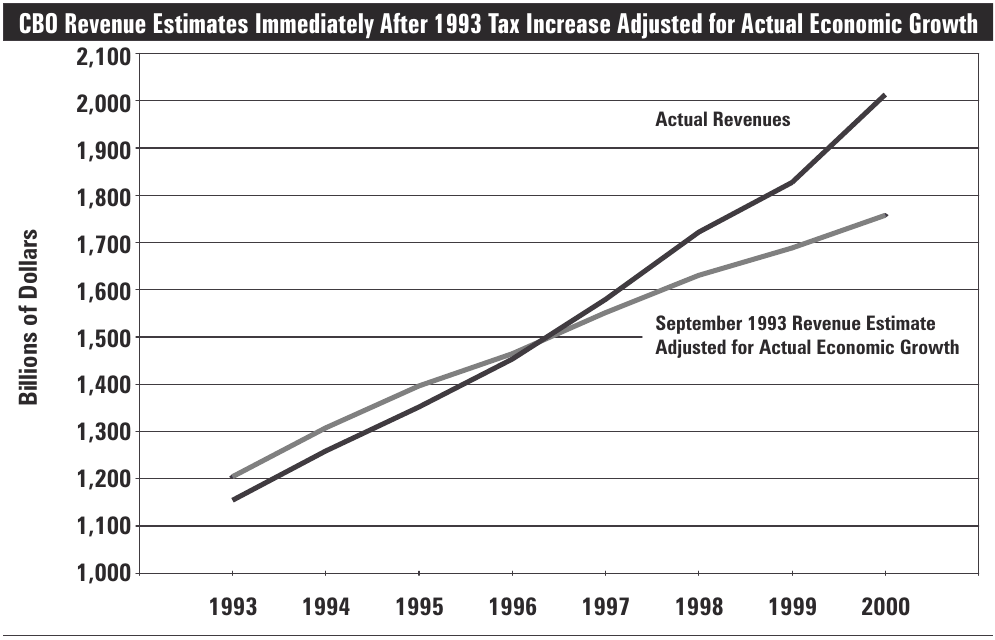
The striking thing about Figure 5 is that during the first four years of the revenue-estimating period, CBO would have overestimated revenues had it’s economic growth projections been perfectly accurate. From 1997 onward, however, CBO would have underestimated revenues. This figure reveals the systematic bias endemic to CBO’s demand-side model. Factoring the economic growth error out of the equation, CBO overestimated the positive revenue effect of hiking tax rates in the first four years after the tax increase took effect because it ignored their dampening effect on growth; and CBO underestimated the sensitivity of the tax code to rising economic growth once the economy picked up steam. The clincher is that revenues began to outstrip CBO’s post-tax hike revenue estimates after tax rates were cut in 1997 and the high-tech revolution was unleashed to propel the economy forward.
Clearly, what happened was that from 1993 through 1996, higher tax rates slowed economic growth, which depressed revenues, which caused large deficits to persist. The Fed, in an effort to "accommodate" the tax rate increases, loosened monetary policy and allowed a mini-inflation to ignite. Once the Fed recognized its error, reversed course and snuffed out inflation and after the Congress cut the capital gains tax rate, investment boomed and the high tech/Internet revolution was off to the races, counteracting the depressive effect of the 1993 tax increases on growth, causing productivity to sky rocket and growth to accelerate.
Further clouding what happened subsequent to the 1993 tax rate increases was CBO’s consistent underestimate of the sensitivity of the progressive federal tax code to changes in economic growth.19 The question no one has attempted to answer, surprisingly, is what would have happened to the deficit/surplus if the “new economic strategy” had never been implemented? Al Gore would have us believe we would still be in a sea of red ink. Figure 6 reveals just the opposite.
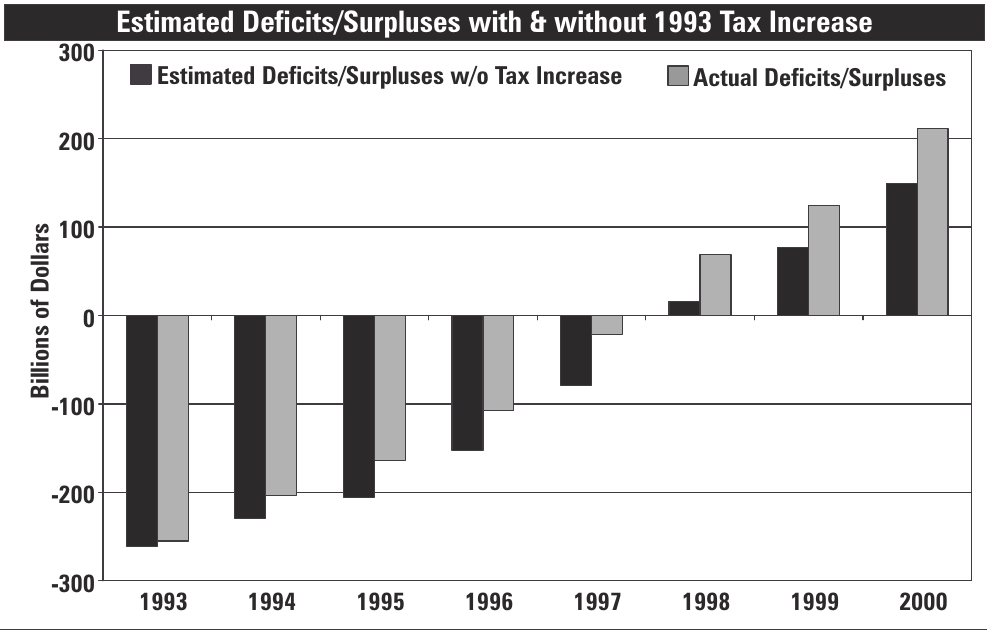
In order to estimate what path revenues would have taken since 1993 if the 1993 tax rate increase had never occurred, we begin with CBO’s last revenue forecast before the tax increases were enacted, January, 1993. This forecast was updated and adjusted to take into account the difference between actual GDP growth and CBO’s economic growth forecast at the time, and adjustment was made for the structural error built into CBO’s 1993 forecast due to it’s revenue model’s underestimate of the sensitivity of the progressive federal tax code to changes in economic growth.
Even under the most conservative of assumptions, namely that the economic expansion would have remained on the slow track through 1995 without the 1993 tax increase, the budget still would have come into balance at about the same time and surpluses of the same relative magnitude would have emerged. In fact, had the NEP never have been put into place and had the tax rate reductions been enacted that supply side economists were encouraging, the economy very likely would have grown faster prior to 1996, and the budget would have come into balance even sooner.
Conclusion
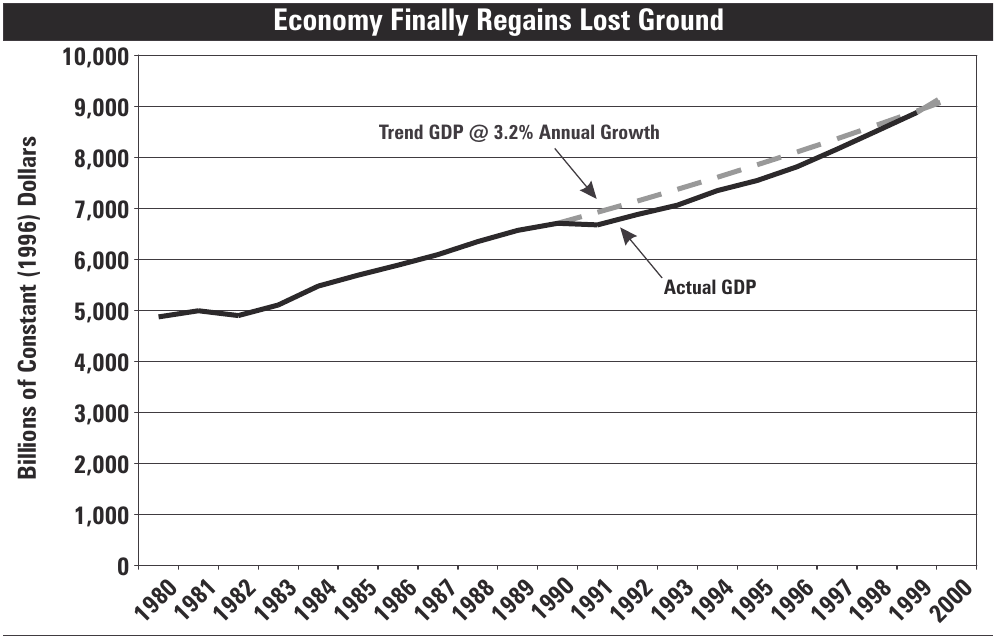
Far from giving America “the greatest prosperity ever,” the Clinton-Gore NEP actually acted as a drag on prosperity every step of the way. When the Internet burst on the scene in 1996 and the capital gains tax rate was cut in 1997, the economy was finally unshackled and able to overcome the Clinton-Gore drag. It embarked on a drive back toward the trend level it should have been on throughout the 1990s. Figure 7 closes the book on the NEP. American ingenuity and lower tax rates finally got America back on track.
Endnotes
- The Omnibus Budget Reconciliation Act of 1993, Pub. L. 103-66, Aug. 10, 1993, 107 Stat. 312 ↩
- Presidential Debate at the University of Massachusetts, October 3, 2000. ↩
- The Economic and Budget Outlook, Congressional Budget Office, September, 1993, p. ix. ↩
- The Clinton-Gore Administration expressed it this way: “The legacy of large and growing Federal budget deficits required that first attention be devoted to their reduction, so as to free up resources for expansion of private physical capital. . .For too long, Federal budget deficits have been gobbling up an inordinate share of the Nation’s saving, thereby keeping real interest rates too high. . .Reducing the budget deficit was a necessary part of clearing away the financial underbrush that had grown up around us in the 1980s—so that economic growth could be put on a sounder and more sustained footing.” Economic Report of the President, February, 1994, p. 31. ↩
- In January, 1999, The Institute for Policy Innovation’s Economic Scorecard described the 1990s economy this way: This recovery is now the second longest in history. . .However, the strength of this recovery still continues to lag those of the 1960s and 1980s. At similar points—31 quarters from trough—real GDP had increased by 48 percent during the recovery of the 1960s and by 34 percent during the 1980s. Real GDP in this expansion has advanced only 27 percent since March 1991. . .Below-trend growth has come at a cost. Since 1991, the economy has foregone almost $3.9 trillion (expressed in $1992) in output.” See “Taking Growth for Granted,” Economic Scorecard, Fourth Quarter, 1998. A substandard increase in the overall size of the economy persisted even as late as the beginning of 1999 because in spite of strong 4+% growth in both 1998 and 1999, the sluggish growth early in the recovery prevented the economy from taking full advantage of compounding. ↩
- “Some analysts speculate that the high growth rate of labor productivity (output per hour in nonfarm business) during the recovery heralds a new trend after more than two decades of disappointing growth. The Congressional Budget Office, however, considers the rebound to represent more a normal cyclical phenomenon than a harbinger of a new trend. . . investment in computers, deregulation, intensified global competition, and increases in the quality of the labor force occurred throughout the 1980s and cannot explain the sudden jump in productivity now.” CBO, op. cit., p. 20. ↩
- The Economic Report of the President, February, 1994, p. 91. ↩
- Ibid., p. 87. ↩
- The Federal Open Market Committee hiked the Fed Funds rate up over nine percent in 1989 and left it above eight percent throughout most of 1990. ↩
- One of those supply-side economists, Richard W. Rahn, summed up the situation recently: “Clearly something happened eighteen years ago that fundamentally altered the U.S. economy for the better and, to this day, is providing dividends. That change was a sharp reduction in the cost of labor and capital, primarily because of the steep cut in marginal tax rates and improved depreciation allowances, coupled with the end of high rates of inflation. These policies and the reduction in capital gains taxes unleashed the shackles that had bound entrepreneurs and venture capitalists. The high-risk investments of the entrepreneurial class are now providing the surge in productivity that is resulting in both rapidly rising living standards for most Americans and the surge in government revenues. Could the computer, information, communications revolutions have made the same progress under the old policies? Clearly, no.” See “Who gave us the surplus?” The Washington Times, Tuesday, October 24, 2000. ↩
- See for example, Lawrence A. Hunter, “The Never-Ending Recession,” The Wall Street Journal, September 19, 1991. ↩
- This contrasts to a classical supply-side framework that prescribes reducing tax rates to raise the after-tax rate of return to work, saving and investment, which fetches more of each into the market, which increases the supply of labor and capital, which raises productivity and leads to faster non-inflationary economic growth. ↩
- “There are limits, however, to the amount of deficit reduction an economy can be expected to withstand within a short period without endangering economic growth. Economic Report of the President, op. Cit., p. 37. ↩
- CBO, op. cit., pp. 16 & 17. ↩
- Ibid. ↩
- Although the tax increase was not enacted into law until August, 1993, it’s provisions were made retroactive to January of that year so that 1993 revenues were affected by the provisions of the Act. ↩
- “Different This Time?” Economic Scorecard, Institute for Policy Innovation, Fourth Quarter, 1999. ↩
- The aberrant 4 percent growth in 1994 was in large part due to monetary policy engineered by the Fed to “accommodate” the tax increase with looser monetary policy. For an account of the tacit agreement between the White House and the Fed to “accommodate” the tax hike with lower interest rates, see Bob Woodward, The Choice, New York: Simon & Schuster, 1996. ↩
- See, Lawrence A. Hunter, The Case for a $Trillion+ Tax Cut, IPI Policy Report - # 147, September, 15, 1998. ↩
About the Author
Dr. Lawrence A. Hunter is Chief Economist at Empower America. He served as a member of Presidential candidate Bob Dole’s Task Force on Tax Reduction and Tax Reform. During the 103rd and 104th Congresses, Dr. Hunter served on the staff of the Joint Economic Committee, first as Republican Staff Director and later as the Chief Economic Advisor to the Vice Chairman where he was the lead staff person in charge of putting together the economic growth and tax cut component of the Contract With America. Prior to joining the JEC staff in 1993, Dr. Hunter was with the U.S. Chamber of Commerce for five years where he served first as Deputy Chief Economist and later as Chief Economist and Vice President. Dr. Hunter received his Ph.D. from the University of Minnesota in 1981.
Original Publication Information
Institute for Policy Innovation · IPI Center for Tax Analysis · IPI Issue Brief · November 3, 2000
Copyright ©2000 Institute for Policy Innovation
Nothing from this document may be reproduced or transmitted in any form or by any means, electronic or mechanical, including photocopying, recording, or by any information storage and retrieval system, without permission in writing from the publisher, unless such reproduction is properly attributed clearly and legibly on every page, screen or file.
The views expressed in this publication do not necessarily reflect the views of the Institute for Policy Innovation, or of its directors, nor is anything written here an attempt to aid or hinder the passage of any legislation before Congress.
Contact information as printed in 2000:
Direct all inquiries to:
Institute for Policy Innovation
250 South Stemmons,
Suite 215
Lewisville, TX 75067
(972) 874-5139 [voice]
(972) 874-5144 [fax]
Email: ipi@ipi.org
Website: www.ipi.org