
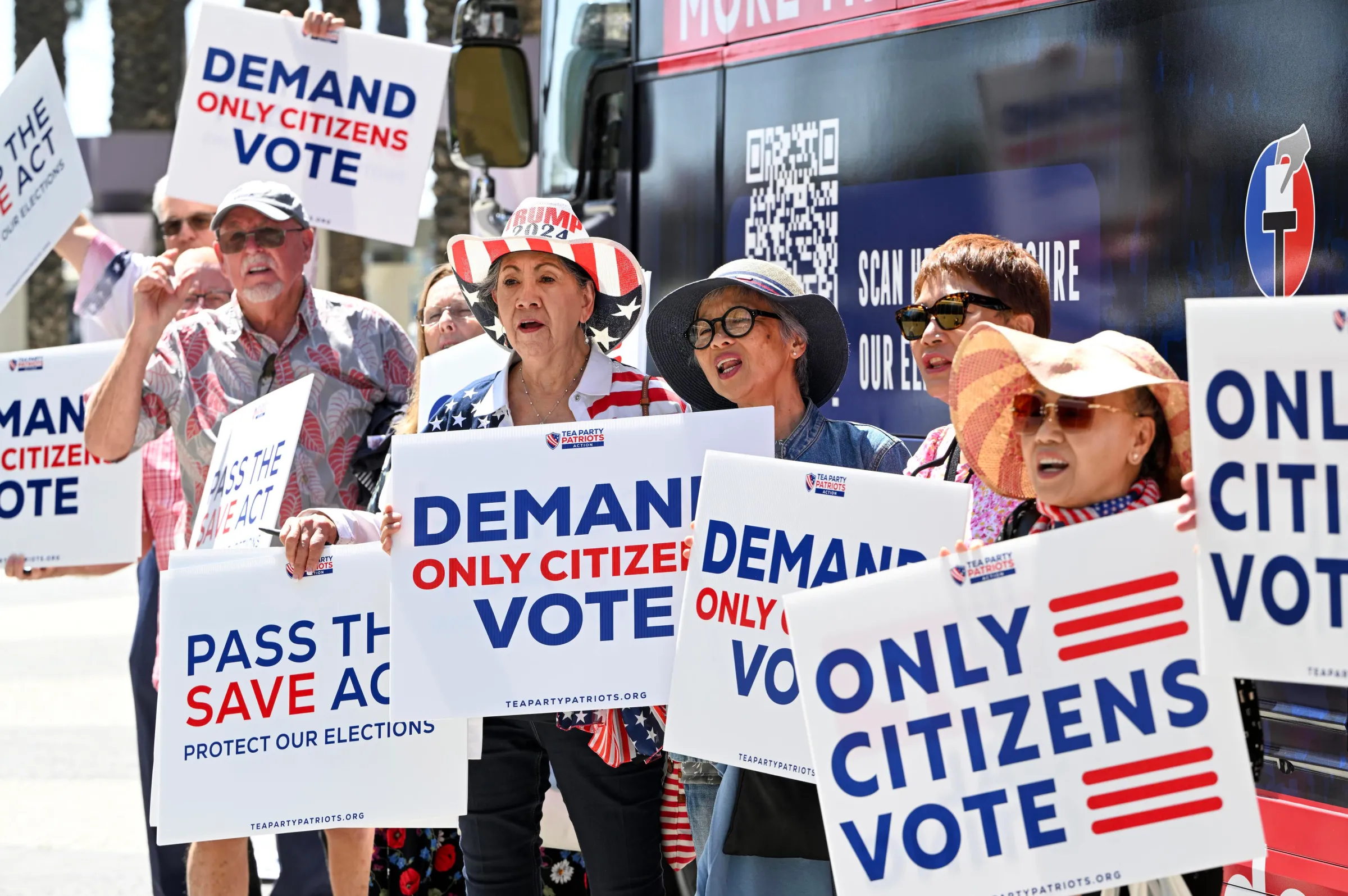
 If you pay attention to politics, you’ve been hearing about the SAVE America Act for nearly all of 2026. President Trump includes it in almost every public comment and has held other legislation hostage to Congress passing the SAVE America Act.
Many elected Republicans and social media jockeys have insisted that without the SAVE America Act, our elections are corrupt and the republic is doomed.
Which is odd, since we just celebrated 250 years of the American republic without the SAVE America Act.
If it’s so vital, why can’t Congress pass it?
Maybe we should take a look and see what’s actually in the bill.
The SAVE America Act puts conditions on “federal elections” conducted by the states. Remember, no elections are administered by the federal government. Elections are run by governments below the federal level: states, counties, cities and various kinds of districts.
A “federal election” in this case involves candidates for federal office. So only if president, senator or House seat is on the ballot.
The SAVE America Act amends the National Voter Registration Act of 1993 to prohibit states from processing voter registration applications without documentation of citizenship, such as a U.S. passport, a REAL ID-compliant driver's license indicating citizenship, or a birth certificate paired with a government-issued photo ID. It thus eliminates online and mail-in voter registration for most applicants by requiring them to present these documents in person to an election official.
It imposes strict photo ID requirements for both in-person and absentee voting, excluding common forms of identification like student IDs or non-enhanced driver's licenses that do not explicitly state citizenship.
That would pass Congress by 80 percent. But that’s not all that’s in the bill.
It mandates that states remove non-citizens from voter rolls based on data matches with federal agencies and requires states to share unredacted voter registration lists with the Department of Homeland Security. So, states must let the federal government access, inspect, review, and edit state voter registration lists.
This is probably a constitutional violation. And while a few states have already voluntarily done this, it revealed nothing statistically insignificant.
It creates a private right of action allowing lawsuits against election officials who register voters without proper documentation and establishes criminal penalties for violations.
An exciting new field for trial lawyers. And serious criminal liability for a clerical job.
It effectively ends online and mail-in voter registration for federal elections, as these methods cannot satisfy the in-person document inspection requirement. Millions of citizens who update their registration via mail or online (e.g., after moving or changing a name) will be forced to visit election offices physically.
This would inconvenience millions of Americans over something that is mostly a non-issue.
Because the bill mandates that documentary proof of citizenship be presented in person to an election official, it effectively eliminates voter registration drives conducted by third-party groups.
So, no more voter registration drives at church.
Now that you know what is really in the SAVE America Act, does it strike you as more important than anything else Congress could possibly be doing? It is worth ending the filibuster over?
Or is it possible that this is mostly an unnecessary intrusion on federalism designed to satisfy a president’s private obsession?
You might support every one of these provisions.
But hopefully now you can also understand why some thoughtful people might not.