

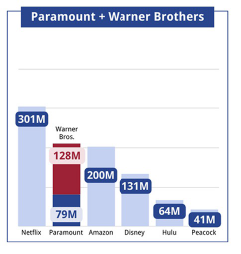
Earlier this year we wrote that Netflix is the dominant streaming company in terms of paid subscribers (more than double Disney+), attention share (about double its nearest competitor), and profitability (only long-term profitable company).
We also said that Netflix’s history of price increases indicates that, if merged with Warner Brothers, it could set rates across the entire sector.
Some things have changed and some have not changed.
What’s changed is that Paramount – not Netflix – is now poised to merge with Warner Bros-Discovery (the WBD board is set to vote on April 23rd). While there are likely many reasons, one significant cause is that, as Alabama Attorney General Steve Marshall said, “antitrust policy worked.” In other words, Netflix probably recognized that extending its 100 million streaming subscribers lead wouldn’t be approved by regulators.
What has not changed is Netflix’s capacity to flex its dominant marketplace position and raise its prices again, as it did three weeks ago, on March 26th.
 We previously noted that Netflix’s price increases averaging every 18 months were indicative of a market-dominant player leveraging its market power, but their pace has increased. This latest increase is second in the last fifteen months and marks 150% increase from 2013.
When he testified in Washington this winter, CEO Ted Sarandos “insisted Netflix and HBO Max are complementary, and claimed that 80% of HBO Max subscribers also subscribe to Netflix. ’We will give consumers more content for less.’” (Variety)
Instead, the opposite has happened: Netflix won’t merge with HBO Max and yet they have raised prices.
This week Senate Antitrust Minority Leader Cory Booker will hold a forum on Paramount’s plans for WBD. Predictably, a cast of liberal actors, actresses, and Hollywood-types will step forward and lament what they assume are Paramount’s plans to make more centrist programming and news coverage.
However, what you won’t hear is that Paramount is anywhere near the dominant position currently held – and not threatened – by combining with HBO Max. In the end, progressive state attorney’s general can complain, but they cannot make a substantive antitrust case against Paramount.
Instead, we continue to believe that a merger between Warner Bros. and Paramount will not unseat Netflix from atop the “streaming wars,” but it could establish the resulting company as a close contender. Such an outcome certainly would not harm consumers, since it would force Netflix (and other providers) to continue to innovate and offer competitive prices.